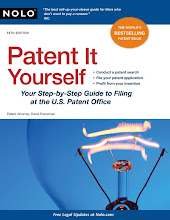
Thanks for buying Patent It Yourself. Below are the updates for the 13th edition, arranged by date posted and then by page number. I suggest that you check the below updates before each time you use PIY. Write the date each time you check these updates on the title page of PIY; thereafter check only the updates that were posted after the date you last checked. (Updates to the 12th (in purple) are typed after the updates to the 13th.)
►Posted 2008 May 5:
P. 101, col. 2, lines 8-9 up, change
“patents (U.S. and foreign patent applications--effective as of their filing date),”
to
--“U.S. and foreign patents, published U.S. patent applications (effective as of their filing date),--.
P. 178, col. 1, after Inventor’s Commandment 12 insert:
New Patent Revision Pending. A complete revision of the patent statutes is pending (H.R. 1908 and S. 1145 in the 110th Congress, 2007), but these bills have been derailed because of protests by independent inventors, Nobel laureates, friends of the patent system, concerned legislators, and the drug companies. Complete information about the bill and the arguments against its provisions can be found on the Professional Inventors’ Alliance site, http://www.piausa.org/.
While this bill has some provisions that would help independent inventors, I believe that its overall effect would be harmful. I urge you to call and write to your federal representatives and senators to urge them to oppose this bill in order to keep our the patent system strong since I believe that this is one of the main factors that has made the US a technological leader.
I will post the resolution of these issues on this update site, so check back here occasionally or before you do any other patent work.
P. 178, col. 2, last line, change to
--a court could use to limit your invention--see--.
P. 179, col. 2, l. 13, before “Advantages.” insert –f.1.--.
P. 186, col. 2, after last line, insert
--If you want to help prevent readers of your patent from copying and using your program listing, it’s helpful to include a copyright notice in the patent application. PTO Rule 71 (37 CFR 1.71) specifies the notice to include in the application. However putting such a notice in will not prevent crooks from copying your source code (SC), so it's best not to include it, if at all possible. You may provide just the object code or a detailed flowchart.--
P. 190, col. 2, line 15 up, delete “does”.
P. 195, col. 1, l. 9 up, before “Advantages.” insert –f1--.
P. 259, col. 2, line 9 up, after “satisfied” insert:
–The importance of double checking what you write after allowing the lapse of a day or so is illustrated by the following quotes from some actual church bulletins:
“The rummage sale will enable you to get rid of things not worth keeping. Don't forget your husbands.”
“Miss Charlene Mason sang "I will not pass this way again," giving obvious pleasure to the congregation.”
“Potluck supper Sunday at 5:00 PM--prayer and medication to follow.”
“For those of you who have children and don't know it, we have a nursery downstairs.”
“A bean supper will be held on Tuesday evening in the church hall. Music will follow.”--
P. 291, col. 2, after line 3 up, insert:
--Here are some other programs that can convert documents to pdf: ABXPDF Writer (free); Open Office (free); Easy Office (adware); PDF Redirect (free); PDF 995 (adware); Primo PDF (free).--
P. 339, col. 1, line 11, after “Chapter 5,” insert –U.S.--.
P. 414, col. 1, above Sec. N, insert:
--In Seagate v USSC, 2007 August, the CAFC ruled that owners must prove opponents knew or should have known they probably were infringing and continued anyway. The ruling said it isn't enough to show an accused infringer knew of a patent and did nothing about it.--
P. 417, col. 1, after line 18 insert:
IP Contingency Consortium, 8911 Research Drive, Irvine, CA 92618; (949) 788-9968; info@ipcontingency.com; http://www.ipcontingency.com/
This organization represents a group of law firms and licensing companies that assists corporations and individuals in the enforcement of their patent, trademark, and copyright rights on a contingency basis.
Beware of any litigator or service that requires any up-front fees.
Appendix 7, Form 3-1, p. 1, in the Nondisclosure Agreement, change the third checkbox and text thereafter to:
--[ ] understands that Disclosing Party will show the above materials to Receiving Party on ________________ (date) but will keep such confidential Information in Disclosing Party’s possession (______________).--.
Index: Add the following entries to the Index:
Claim chart, p. 405
Rule 131, p. 346
►Posted 2008 July 7:
Ch. 10, Sec. G.: Clarification: P. 270, col. 1, line 8 up, after 45 days" insert --of the date you foreign-file--.
►Posted 2008 Oct 3:
New PTO Fees Effective 2008 Oct 2
37 CFR Sec. Item Large entity/Small entity
Patent Application Filing Fees
1.16(a) Filing fee: UTILITY appn. on paper (filing 330/165 + search 540/270 + exam 220/110) = $1090/$545
1.16(a)(1) Filing fee UTILITY appn. EFSWeb (filing 330/82 + search 540/270 + exam 140/70) = $1090/$462
1.16(b) Each independent claim over three, add $220/$110
1.16(i) Each total claim in excess of 20, add $52/$26
1.16(d) Multiple dependent claim, add $390/$195
1.16(f) Late UTILITY filing fee or oath, surcharge $130/$65
1.16(s) UTILITY appn: each 50 sheets over 100, add $270/$135
1.17(e) Request For Continued Examination (RCE) $810/$405
1.16(k) Filing fee for PROVISIONAL appn (PPA) $220/$110
1.16(g) Late PPA filing fee or oath, surcharge $50/$25
1.16(f) Basic filing fee for DESIGN appn. (filing 220/110 + search 540/270 + exam 140/70) = $370/$185
1.17(k) Design appn, request expedited exam. (Rocket Dkt) $900/$900
1.16(g) Basic filing fee--PLANT application (filing 220/110 + search 330/165 + exam 170/85) = $590/$295
1.21(h) Record patent assignment $40/$40
Patent Application Examination-Related Fees
1.17(a)(1) Extension for response within 1st month $130/$65
1.17(a)(2) Extension for response within 2d month $490/$245
1.17(a)(3) Extension for response within 3d month $1110/$555
1.17(a)(4) Extension for response within 4th month $1730/$865
1.17(a)(5) Extension for response within 5th month $2350/$1175
1.17(m) Petition to revive unintentionally abandoned appn. $1620/$810
1.17(l) Petition to revive unavoidably abandoned appn. $540/$270
1.17(p) Late IDS, filing $180/$180
41.20(b)(1), (2) Appeal, filing notice of or filing brief $540/$270
41.20(b)(3) Appeal, request for oral hearing $1080/$540
1.17(f), (g), (h) Petitions $130, $200, or $400
1.19(b)(1)(i)(A) Copy patent appn. as filed, certified $20/$20
1.19(b)(1)(i)(B) Copy patent file wrapper, certified (up to 400 pp) $200/$200
1.19(b)(1)(ii)(B) Copy paten file wrapper, certified on CD $55/$55
Patent Application Issue Fees
1.18(a) Issue fee--UTILITY application $1510/$755
1.18(a) Publication Fee, UTILITY appn $300/$300
1.18(b) Issue fee--DESIGN application $860/$430
1.18(c) Issue fee--PLANT application $1190/$595
Patent Maintenance And Post-Issue Fees
1.20(e) Maintenance fee—due between 3.0 & 3.5 years $980/$490
1.20(f) Maintenance fee-- due between 7.0 & 7.5 years $2480/$1240
1.20(g) Maintenance fee-- due between 11.0 &11.5 years $4110/$2055
1.20(h) Surcharge—late payment within 6 months $130/$65
1.20(i)(1) Surcharge after unavoidable expiration $700/$700
1.20(i)(2) Surcharge after unintentional expiration $1640/$1640
1.20(a) Certificate of Correction--applicant’s mistake $100/$100
1.20(c)(1) Examination request—Ex Parte $2520/$2520
1.20(c)(2) Examination request—Inter Partes $8800/$8800
Patent Cooperation Treaty (PCT) Fees
1.445(a)(1) PCT Transmittal Fee $300
1.445(b)(2) Search Fee $1800
-- International filing fee, 1st 30 pp. $1338
-- Supplemental fee, each p. over 30 $15
-- Handling fee $171
Trademark Fees
2.6(a)(1)(i) Trademark: appn to register, paper filing $370
2.6(a)(1)(ii) Trademark: appn to register, Internet filing $325
2.6(a)(1)(iii) TM: appn to register Teas+ (simplified) filing $ 275
2.6(a)(2), (3) Amnt to allege use or Statement of use, filing $100
2.6(a)(4) Request 6-month extension to file Statement of Use $150
2.6(a)(5) Application to renew registration $400
2.6(a)(12), (13) File Declaration Under §8 ($100) and §13 ($200) both $300
►Posted 2008 Oct 31:
Ch. 5, Sec. C.: Bilski case: P. 95, col. 1, at end of sec. b. insert
►Posted 2008 Dec 2:
►Posted 2009 Jan 16:
Ch. 9, Sec. G.13.: Beauregard Claims OK: P. 235, col. 2, change the first full paragraph to read
Beauregard Claims Are A Way Around Bilski: Contrary to what you might think, a Beauregard claim is not an assertion or demand by the flamboyant Confederate General P. G. T. Beauregard. Rather the name comes from a 1994 decision in which some patent applicants appealed a rejection of claims to an article of manufacture, such as a computer, containing a storage medium (e.g., a CD or memory), which stored instructions for causing the computer to perform a process. The PTO’s Board of Appeals and Interferences strangely and erroneously held that such claims were printed matter and thus non-statutory subject matter. When the applicants appealed to the CAFC, the PTO conceded that the claims were patentable subject matter under 35 U.S.C. § 101 and must be examined under 35 U.S.C. §§ 102 and 103. The court held that, in view of the PTO’s concession, there was no longer any case or controversy and thus it vacated the Board’s decision. In re Beauregard, 53 F.3d 1583 (Fed.Cir. 1995). In a post-Bilski decision, Ex parte Bo Li, Appeal 2008-1213 (BAPI 2008), the Board fell in line and reversed an examiner’s non-statutory subject matter rejection of a Beauregard claim since the claim was directed to a product and thus Bilski did not apply.
The Beauregard and Bo Li decisions provide a way to effectively claim a computer-implemented process without running afoul of the Bilski rule, which requires that process claims must recite a process that is either (1) tied in a substantial way to a particular machine or apparatus, or (2) transforms an article into a different state or thing. For example, the following claim would be barred under the Bilski rule:
1A. A process for selecting a security to buy, comprising:
(a) obtaining a list of securities that have a price-earnings ratio less than that of the average price-earnings ratio of a preselected market average,
(b) identifying from said list those securities that pay a yearly dividend in excess of 4 per centum,
(c) selecting the security from step (b) that has the highest earnings growth rate over the past five years.
However here is claim 1A transformed into a Beauregard claim, so it would pass muster:
1B. A computer program product comprising:
(a) a computer processor having a humanly sensible output,
(b) a computer-useable storage medium having a computer-readable program embedded therein, said computer-readable program code being executable by said computer processor:
(c) said computer program arranged to cause said computer processor to scan a list of securities and select those securities that have a price-earnings ratio less than that of the average price-earnings ratio of a preselected market average and store those securities as a first list on said storage medium,
(d) said computer program then arranged to cause said computer processor to scan said first list on said storage medium and select those securities that pay a yearly dividend in excess of 4 per centum per annum and store those securities as a second list on said storage medium, and
(e) said computer program then arranged cause said computer processor to scan said second list and select the security that that has the highest earnings growth rate over the past five years and store said security on said storage medium and display the name of said security on said humanly sensible output.
While the difference between claims 1A and 1B may seem trivial and senseless, the reality is that the court has decreed that the former would not be acceptable and the latter would be OK, so we must live with these rules and cast our claims in an acceptable format until and unless a subsequent court decision or legislation supersedes Bilski.
►Posted 2009 Jan 18:
►Posted 2009 Jan 20:
Ch. 10, Sec. N: On p. 280, col. 2, after the first paragraph, insert:
One way to determine whether a reference is relevant enough to cite as prior art in your IDS is to consider not citing it in your IDS and then assume you get a patent. Assume that an infringer that you sued found out that you knew about the reference yet didn't cite it. If the infringer then cited the reference you withheld to the judge and charged you with fraud on the PTO for not citing it, would the judge be likely to consider that the reference was relevant enough that you should have cited it to avoid fraud on the PTO?
Note that PTO Rule 56 states that applicants should examine the following to be sure that they disclose all relevant prior art:
(1) Prior art cited in search reports of a foreign patent office in a counterpart application.
(2) The closest information over which individuals associated with the filing or prosecution of a patent application believe any pending claim patentably defines, to make sure that any material information contained therein is disclosed to the Office.
The PTO considers that information is material to patentability when it is not cumulative to information already of record or being made of record in the application, and
(1) It establishes, by itself or in combination with other information, a prima facie (on its face) case of unpatentability of a claim; or
(2) It refutes, or is inconsistent with, a position the applicant takes in (i) Opposing an argument of unpatentability relied on by the Office, or (ii) Asserting an argument of patentability.
A prima facie case of unpatentability is established when the information compels a conclusion that a claim is unpatentable under the preponderance of evidence, burden-of-proof standard, giving each term in the claim its broadest reasonable construction consistent with the specification, and before any consideration is given to evidence which may be submitted in an attempt to establish a contrary conclusion of patentability.
Ch. 10, Sec. R, PDF Resolution Requirement: On p. 292, col. 2, at the end of Item 2, insert:
--All PDF documents submitted via EFS-Web must have a minimum resolution of 300 DPI and a white background. A lower resolution or a document with a color background may delay processing and publication of your application.
Ch. 10, Sec. R, PDF Creation: On p. 293, col. 1, delete the sidebar, “2007 Update: PTO Site . . .” (The PTO has fixed its forms so that Adobe Reader 8.0 can be used.)
Ch. 11, Sec. J.1., insert at the end:
HOW TO GET FUNDING FROM A VC: Popular Science for June 2008, p. 53, has an interview with Ari Zoldan, CEO of Quantum networks, a venture capital (VC) firm. Mr. Zoldan explains how to convince A VC to fund your invention. First, don't send a letter or don't e-mail. Call the CEO and pitch your invention briefly. If the CEO is interested, he'll ask you to come in for a minute meeting. If the CEO is not interested try elsewhere. Second, you want an investor who will be actively involved. This may be a hassle, but you can use the CEO’s knowledge and contacts. Third, ask the VC for a list of companies they’ve funded. Call to get their opinion of the VC. Third, never agree to give the VC a majority control of your company. Fourth, bear in mind that VCs are looking at two things: the product and the inventor's skills and expertise. Be sure to cover these issues in your presentation. Fifth, get the VC to sign a non-disclosure agreement. It’s common industry practice in the industry and the VC will respect you. Sixth, always bring a business plan to the meeting. Seventh, bring your prototype too. Its looks are not as important as its function and workability. Eighth, don't be intimidated by VCs. They need you as much as you need them; they have to find ventures to fund so they can show their investors a return.
Ch. 11, Sec. B.1., p. 301 insert at the end of the “Don’t Use a Fee-Based Inventor Exploiter” sidebar:
As reported by the Associated Press on July 14, 2008, one Pittsburgh, PA-based invention firm (Davison and Associates, Inc.) that was sued by the FTC for defrauding inventors settled by paying a fine of $10.7 million. In addition they agreed to pay almost $11 million to investors who paid the firm to develop their inventions. Davison issued a statement saying it has added risk-disclosure statements to its marketing materials to tell inventors that "new product design is a high-risk venture."
Ch. 9, Sec. J.2. p. 243, col. 1, after fifth paragraph (ending with “(1, 2, 3, etc.).” insert:
--Again remember that in an independent apparatus claim (means or structural) you must recite a part or a series of parts. In a claim which is dependent upon an apparatus claim you must recite an additional part or modify a previously recited part. In an independent method claim you must recite a step or a series of steps. In a claim which is dependent upon an method claim you must recite an additional step or modify a previously recited step or part.
►Posted 2009 Jan 21:
Ch. 5, Sec. C: On p. 97, col. 2, in sidebar, third item, after “mountain)” insert
--. However Napier’s “bones” (rods used to multiply by adding) would clearly be SSM.
• Processes that (1) are not tied in a substantial way to a particular machine or apparatus, or (2) do not transform an article into a different state or thing. See the Bilski decision in Chs. 5 and 9.--
Ch 8, Sec I.1.: On p. 191, col. 1, after the “Write Clearly” section insert:
--Avoid Solecisms
Although the PTO isn’t big on objecting to solecisms (grammar and spelling errors) it will behoove you to avoid solecisms in your application and all of your correspondence. This will cause work to get more respect and may grease the way to easier approval. So try your best to avoid these errors by taking the time to carefully proofread or use a spelling and grammar checker, either software or human. Here are some examples of common grammar errors that I found in redacting patent applications:
Wrong: “lever 202’s left end”. Right: --the left end of lever 202--.
Wrong: “connected to switch 502 wires”. Right: --connected to the wires leading to switch 202--.
Ch 8, Sec K.: On p. 202, change “the heading, “Writing General” to –Writing Generally—and add the following item in this checklist:
--[ ] Specification has been carefully checked to eliminate all solecisms.--
►Posted 2009 Jan 23:
Ch. 5, Sec. F.4.: On p. 110, add the following after the last word (“made.”) in Factor 12:
--Another example is the change in the packaging of potato chips from expensive boxes to cheaper flexible bags. There was a widespread belief that chips had to be packaged in boxes to prevent breakage of the chips during shipping and handling. An iconoclastic inventor discovered that packaging the chips in bags did not result in any increase in breakage. This contrarian discovery militated strongly in favor of nonobviousness.—
Ch. 8, Sec. I.2.j.: On p. 197, col. 1, insert another TIP as follows:
--If your invention is an improvement to a prior-art (PA) device, don’t describe the PA device in detail in the PA section and state, in the description of your invention, that your device improves upon the PA device by making the following change(s): ______. This will isolate your changes, making it easier for an examiner or future adversary to invalidate your patent by showing a reference with just the changes. Instead describe the PA device generally in your PA section and then, in the description of your invention, describe your whole device in detail and in a manner different from the description of the PA device. This will make it much more difficult for anyone to invalidate your invention.--
Ch. 8, Sec. I.2.j.: On p. 197, col. 2, in “Use of . . .” sidebar, at end of ¶ 4 (ending in “head 12.’”) insert:
--(Plural nouns don’t take an article. Example “The device has handles 10 and 12.”)—
Ch. 13, Sec. E.1.: P. 353, col. 2, line 3, after “underlining.” insert:
--If you are doing an amendment(s) with numerous strikethroughs and underlining, you will find it easier to format these by adding the appropriate symbol to your toolbar. This can be readily done in most word processing programs. E.g., in MS Word, go to Tools/Customize/ Commands/Categories/Format and click on and drag the Underline and Strikethrough symbols from the right pane to your toolbar. Then to underline or strikethrough any text, simply select the text and click the symbol on the toolbar.--
►Posted 2009 Jan 25:
Ch. 9, Sec. C.1.a.: P. 224, col. 1, in the claim (italicized), line 2, delete "the steps".
Ch. 9, Sec. K: P. 246, col. 1, line 6, after "you're" insert --usually--.
►Posted 2009 Jan 26:
Ch. 15, Sec J.: P. 409, col. 2, rewrite text in "Design Patent Infringement" sidebar as follows:
--Design patent infringement is determiend by the Ordinary Observer Test: Is the accused design so similar to the claimed design that a prospective purchaser familiar with the prior art would be deceived by the similarity between the two designs? I.e., would an ordinary observer be induced to purchase one supposing it to be the other? Egyptian Goddess, Inc. v. Swisa, Inc., 498 F.3d 1354 (CAFC 2008). As with most evidentary trials, each side will call in its hired gun (expert) to testify that an ordinary observer would or would not be deceived.
►Posted 2009 Jan 27:
P. 244, col. 2 (Ch. 9, Sec. J.2.), add a third Common Misconception as follows:
Common Misconception: If a dependent claim recites a feature or element of the invention, it will protect this feature per se.
Fact: A dependent claim must be read to include all of the features of its referent claim (preceding or independent claim to which it refers). Thus it will not cover the feature it recites per se, but rather will cover that feature in combination with all of the elements of its referent claim.
P. 35, col. 2, line 6 up (Ch. 2, Sec. B): change “compounding” to –companding--.
P. 95, col. 1, line 11, up (Ch. 5, Sec. C.1.b.): Change “Signal” to –Signature--.
►Posted 2009 Jan 28:
P. 158, col. 1, after line 12 (Ch. 6. Sec. L.1.): insert the following:
Patents.com provides a free search site that searches U.S. and foreign patents.
P. 222, col. 1 (Ch. 9, Sec. A.), after line 2 insert:
--Common Misconception: If the devices described in the prior art have disadvantages and a patent application describes an invention that overcomes such disadvantages, the applicant will automatically be entitled to a patent.
Fact: In order to get a patent, the application, in addition to describing an invention that is superior to the prior art in some way, must also contain claims that define an invention that is physically novel over the prior art and such physical novelty must also be unobvious over the prior art, i.e., it must produce new and unexpected results.--
P. 241, col. 2 (Ch. 9, Sec. J.i.), after line 4, insert:
--The value of putting significant subsidiary elements in dependent claims cannot be overstated. A feature that doesn’t seem significant now can prove to be crucial later. One inventor I know (Morrie) submitted a large set of dependent claims to recite every less-important feature of his invention that he could think of, including one that recited that a certain flap was bendable. He got a patent and was involved in a licensing negotiation where the infringer found an earlier patent that showed his complete invention, except for the bendable flap. While the earlier patent invalidated most of Morrie’s claims, fortunately he was able to rely on the still-valid dependent claims that recited the bendable flap to conclude a licensing deal, albeit at a lower rate than he originally wanted.--
P. 272, col. 2, above “Box 17” paragraph (Ch. 10, Sec. I.1.), insert the following:
--Common Misconception: If the PTO publishes your patent application, this indicates that it believes your invention is patentable.
Fact: If you don’t file an NPR at the time of filing the application, the PTO will publish your application 18 months later, regardless of its patentability.--
P. 335, col. 2, above line 9 up (Ch. 13, Sec. A.14.), insert the following:
--The value of an interview cannot be overstated. One pro se applicant that I know (Alex) had a very difficult time getting his case allowed. On my suggestion he traveled to Alexandria, VA to have an interview with his examiner. To his dismay Alex found from discussing the case that the examiner had likely never read his application and definitely did not understand the invention. Fortunately he was able to explain the invention on the spot and, with some claim adjustments, managed to get the case allowed.
One site, www.USPTOExaminers.com, allows attorneys and applicants to post reviews of examiners anonymously.-- ]
►Posted 2009 Feb 1
P. 20, col. 2 under the “Trade Group . . .” sidebar, add another sidebar as follows:
--Registration And Infringement Of Domain Names
Another type of trademark or quasi-trademark is a Domain Name, i.e., the main part of the name of an Internet site, such as http://www.patentityourself.com/.
Domain names are registered with the Internet Corporation For Assigned Names and Numbers (ICANN), which is in effect another trademark office. What can you do if your Domain Name is infringed by someone who registers a Domain Name which is confusingly similar to your Domain Name or to a trademark you own? Several remedies are available. The first and second remedies are trademark litigation under the U.S. Trademark Laws (15 USC 1021 et seq.) or litigation under the Anticybersquatting Consumer Protection Act (ACPA—15 USC 1125(d)). But a third remedy is simpler and easier. You can bring an arbitration under ICANN’s Uniform Dispute Resolution Policy (UDRP). While you can’t recover damages from the infringer under a UDRP arbitration, you can still sue for damages later under the first two remedies and if you win the arbitration, ICANN will order the infringer to cancel or turn over the Domain Name to you. An entire arbitration usually takes only about three months.—
P. 199, col. 2 (Ch. 8, Sec. I.2.j.), par. 4, l. 4: after “(see Chapter 9).” insert
--Several courts have recently restricted applications that disclose only a single embodiment to the single embodiment disclosed, even though the claims may be broader than that embodiment.--
►Posted 2009 Feb 2
P. 9, col. 2 (Ch. 1 Sec. A.), In “Important Definitions” sidebar, after first sentence (ending in “later.”) insert:
--If you think I’m being persnickety to mention this, note that in the patent field words and their meanings are crucial: a single word or comma can often make the difference between allowance or rejection of a set of claims or whether a device infringes a patent or not. So when you work or communicate in this field, you must use words and punctuation precisely and accurately.--
P. 314, col. 1 (Ch. 12, Sec. E.), line 7 of Sec. E, after “(EPO)” insert an asterisk (*) and provide a footnote as follows:
--*Technically, only individual countries (and not associations of countries such as the EPO) can become a member of the PCT. However any PCT member country which is a member of an association of countries that awards a regional patent, such as the EPO, can be designated for a regional patent when filing with the PCT. For purposes of filing, this distinction is immaterial so I will treat such associations of countries as members of the PCT. The following is a list of country associations which grant regional patents and whose constituent countries are members of the PCT: African Regional Intellectual Property Organization (ARIPO), Eurasian Association (EA), EPO (European Patent Office), Organisation Africaine de la Propriété Intellectuelle (OAPI). The member countries of each of these associations are listed at http://www.wipo.int/export/sites/www/pct/en/texts/pdf/reg_des.pdf.--
►Posted 2009 Feb 3
Ch. 8, Sec. I.2.j.: On p. 197, col. 1, insert another TIP as follows:
--Selecting and Arranging the Right Words is Key to Good Writing By Leslie Gordon, BASF Bulletin Contributor
The key to good writing is "variety, rhythm, and balance," according to my graduate journalism text. In addition to selecting the right words, arranging them optimally can add emphasis and improve readability.
Put the subject, verb, and object close together. The subject is the "doer" of the sentence; the verb is the main action; the object (if any) is the recipient of the action.
1. MEDIOCRE: Lisa, encouraged by her science teacher, applied to MIT. (Subject and verb are separated.)
BETTER: Encouraged by her science teacher, Lisa applied to MIT.
2. MEDIOCRE: My dog walker, because he was sick Monday, could not exercise my bulldog.
BETTER: Because he was sick Monday, my dog walker could not exercise my bulldog. (Subject and verb are together.)
Put modifying words near what they modify. A modifier is a word or words that explain, describe, or qualify another.
3. UNCLEAR: Concerned about the possibility of salmonella, the cutting boards were washed.
Since cutting boards don't get concerned, this sentence must be rewritten to avoid a dangling modifier.
BETTER: Concerned about the possibility of salmonella, the chefs washed the cutting boards.
Be especially mindful of modifiers like "only" or "always" because placement can significantly change the meaning. For example:
Only Ann called Dave a louse.
Ann only called Dave a louse.
Ann called only Dave a louse.
Begin and end with punch words. The beginning and end of sentences are more emphatic than the middle. So place words you want to stress--usually the subject, object or verb--at the front or the back.
4. MEDIOCRE: The defendant died two months later while visiting New York. (Emphasizes location.)
BETTER: The defendant died while visiting New York two months later. (Emphasizes time.)
BEST: Two months later, while visiting New York, the defendant died. (Emphasizes the main point.)
If you're uncertain which words carry the most punch, read your sentences aloud.
Reprinted with thanks by permission of Leslie A. Gordon, Esq. and the Bar Association of San Francisco.--
Appendix 1—Abbreviations: P. 436, col. 1, add a new abbreviation:
--NM New Matter--
Appendix 3.A.—Technical Terms: P. 448, In “2. Mounting and Fastening” add a new entry:
--belay (secure)--
P. 450, In “10. Fluid Flow” add a new entry”
--hermetically--
P. 450, In “12. Movement” add a new entry:
--explant (move living tissue)—
Appendix 3.B.—Patent Terms: Pp. 452-457, add the following new entries:
--agent (patent) a person who is licensed by the PTO to represent others in handling patents and patent applications before the PTO. Patent agents are required to have a technical degree or technical knowledge in a specific field.
--attorney (patent) a person who is licensed by the PTO to represent others in handling patents and patent applications before the PTO and who is also licensed to practice law by any state. Patent attorneys are required to have a technical degree or technical knowledge in a specific field.--
Index: P. 551-572, add the following new entries:
--claim chart, 406
computer program listing, submitting, 186, 199
effective date of reference, 101-102
Rule 131, 346--
►Posted 2009 Feb 4
P. 183, col. 2, line 15 (Ch. 8, Sec. F):
change “your presently preferred” to –one--.
P. 194 (Ch. 8, Sec. I.): in the form, penultimate par.:
change “the presently preferred” to –various--.
P. 200, col. 1, line 27 (Ch. 8, Sec. I.2.m.)
delete “preferred”.
P. 203, col. 1, third item up (Ch. 8, Checklist For Draft of Specification—Specification):
change “a preferred embodiment is” to –other variations are--.
P. 203, col. 2, first item (Ch. 8, Checklist For Draft of Specification—Specification):
delete “preferred”; change “Nylon” to –nylon--.
P. 208, first par (Ch. 8, Sample Application):
change “preferred” to –one--.
P. 212, penultimate par (Ch. 8, Sample Application):
change “of the presently preferred” to –present--.
P. 452, col. 1, fifth term (Appendix 3.B.): change to
--best mode a statutory term indicating that a patent application should disclose the way the inventor presently prefers to make the invention. In practice since courts have seized upon terms like this to restrict the scope of the invention, I recommend not using terms like “best mode” or “preferred”. Instead I suggest you fully disclose your presently preferred embodiment and all other reasonable embodiments that you can think of without blessing or endorsing any embodiment.--
►Posted 2009 Feb 5
Ch. 10, Sec. I.2.: P. 275: In the Fee Transmittal form:
Change the Total Amount of Payment from “$700” to --$715--; delete the checkmark in the box before “Charge An additional fees . . .”; and change the amount under “Fees Paid” from “$500” to --$515--. [N.b.: The fees on this form and the form on p. 276 are all obsolete now as they were raised on 2008 Oct 1. For the current fees see my update site or the PTO’s web site.]
Ch. 10, Sec. I.2.: P. 276: In the Credit Card Payment form:
Change “$700” to --$715--.
Ch. 10, Sec. N: P. 280, col. 1, after the penultimate paragraph, insert:
--(If you file via the EFS-Web system (see Sec. R) you should first fill out the PTO/SB/08 form and make pdf copies of any non-U.S. patent references. You will not need a cover letter because the EFS-Web form provides its own cover letter.)--
►Posted 2009 Feb 6
Ch. 13, Sec. E.1.: P. 353, col. 2, line 8:
change the double brackets “[[ . . . ]] to single brackets –[ . . ]--.
Ch. 13, Sec. E.1.: P. 354, col. 2, lines 4 and 13:
change the double brackets “[[ . . . ]] to single brackets –[ . . . ]--.
Ch. 13, Sec. E.1.: P. 354, col. 2, line 7, delete “of”.
Ch. 13, Sec. E.1.: P. 355, col. 1, line 10, underline “said”.
Ch. 13, Sec. E.1.: P. 355, col. 1, lines 18 and 19, change to:
–(d) creating a product image by sensing one of [[said]] a plurality of products with said a sensor . . . --.
Ch. 13, Sec. B.31.: P. 339, col. 1, after line 25, insert:
--Be sure to check the date of all prior art cited against your application since examiners, like all of us humans, sometimes make mistakes. E.g., some time after the PTO published an application of Nokia’s, an examiner examined the application and mistakenly cited the published patent application against itself!--
►Posted 2009 Feb 8
P. 28, col. 1, 4th par. (starts with “Unfair . . .”): (Ch 1, Sec. R.1.): change this par. to:
--Unfair competition (U.C.) law is available as a source of offensive rights under the common-law (judge-made law) rights, the federal “false-designation-of-origin” statute (15 USC 1125(a)), and state U.C. statutes. Under common-law decisions, if a court finds that a product’s design is well-enough known so that the purchasing public associates it with the product’s manufacturer, the court may find that it has acquired a “secondary meaning” and may prohibit the sale of copies, even if no trademark, patent, or copyright rights are available. Wal-Mart Stores, Inc. v. Samara Brothers, Inc., 529 U.S. 205 (2000). Most states have U.C. statutes. E.g., Calif. has a Consumer’s Legal Remedies Act (Civil Code §§ 1750-1784 and Calif. Code of Civil Procedure § 1770), which prohibits 20 categories of illegal acts, including passing off goods or services as those of another or with a deceptive representation, such as a false designation of geographical origin.--
P. 239, col. 1, after par. 3 (starts with “• Antecedents.”) (Ch. 9, Sec. I), add:
--Conversely if in a claim you recite an element and recite the same element again, you must use the article “said” (some attornys now use "the") before the second occurrence. E.g., a lever having . . .; said lever being . . ..”. If you want to recite two similar elements in different parts of the claim, you should use the article “a” or “an” to introduce both elements, but you must use different adjectives to clearly differentiate the levers. E.g., “a prying lever connected to . . .; a force-transmitting lever positioned on . . ..”
P. 300, col. 2, par. 3 (starts with “Examples . . .”), line 4 (Ch. 11, Sec. B1.), after “technologies.” insert:
--ThinkFire.com specializes in patent brokerage and licensing.—
P. 379, col. 1, in sidebar (“How To Cite . . .”) (Ch. 13, Sec. N), delete “Patent” (last word of the title of the sidebar). At the end of the sidebar insert the following new paragraph:
--Use PeerToPatent.org. to (a) enable the public to cite prior art against your application, or (b) to cite prior art with comments and without a fee against applications of others. For applications in the fields of computers, software, business methods, and E-commerce, the NY School of Law, in cooperation with the PTO, currently provides a site to facilitate the above two functions. Function (a): To enable the public to cite prior art against your application to obtain a stronger patent, go to the PeerToPatent site and under “Submit An Application” click the link to obtain a “Peer.Consent” form and follow the instructions. However note that by inviting the public to examine and cite prior art against your application, you risk losing the application since someone in the public may find and cite fatal art against you. Function (b): To find applications that are open to citations by the public, select an appropriate choices on the site, such as “See a list of all applications”, “Be notified of new applications (email or RSS)”, etc. If you find any applications that you feel are not patentable over relevant prior art that you are aware of, click “Learn more . . .” to get instructions for submitting such art to the PTO.--
►Posted 2009 Feb 9
P. 308, col. 1, par. 3 (starts with “To obtain . . .”), lines 5-9 (Ch. 11, Sec. J.2.):
delete “You can get . . . business plan.”
►Posted 2009 Feb 13
P. 195, col. 1, after line 6 (Ch. 8, Sec. I.1.), insert:
--I suggest you cite all prior art US patents and published patent applications, foreign patent publications, and literature in a table, in the same format as on the PTO’s Information Disclosure Statement (IDS) form, PTO/SB/08a. Then discuss (knock) these references later in narrative paragraphs. This makes it easier for the examiner to review your prior art and for you to fill out your IDS later. See an example in the specification of the sample application, Fig 8G later in this chapter.—
P. 204, after the heading, “BACKGROUND—PRIOR ART” insert the following:
--The following is a list of some prior art that presently appears relevant:
[Put the following in a table, as in Form PTO/SB/08a.]
U. S. Patents
PatNr===KindCode=IssDt=====Patentee
4292714=B1======1981-08-09=Walker
etc.
[N.b. Prior art cited in these tables is exemplary for form only and does not correspond with prior art discussed in subsequent narrative paragraphs. Use only the sections of these tables that you need to list the prior art that you’re citing.]
U. S. Patent Application Publications
PubNr.=====KindCode==PubDt=====Applicant
2009123456=B1=======2009-05-22=Briskin
etc.
Foreign Patent Documents
ForDoc#==CntryCd=KindCd=PubDt===App/Patentee
1234567==TZ=====B1====00-12-24=Beresofsky
etc.
Non-Patent Literature Documents
Archer Daniels Midland Company, “Biodiesel Technical Information”, Biodiesel-Technical-Manual.pdf, http://www.admworld.com/. (May 2009)
etc.
--
P. 300, col. 2, after par. 4 (ending in “. . . connect/orgs.html.)” insert
--If you do use a CFIM, I recommend that you never pay a CFIM an upfront fee since then the CFIM is acting like a FBIE (see “Don’t Use a FBIE” sidebar) and make sure that all royalties are sent directly to you, rather than through the CFIM, since the CFIM may have sticky fingers.--
P. 450, under “10. Fluid Flow” (Appendix 3) insert
--trompe (water pipe blower)--
P. 330, col. 2, after par. 4 (ending in “your group.”) (Ch. 13, Sec. A.5.) insert
--I suggest that, on every paper you receive from the PTO you write three date entries as follows:
Received __________________________
Start preparing response by __________
Response due by ___________________
(I suggest you make the “Start preparing response by” date a month ahead of the “Due by” date. If no response is due simply omit the last two lines or write NA” (not applicable) on them.)--
P. 2, col. 1, l. 22, change “We favor this way of proceeding, since” to
--Attorney fees have risen substantially recently, so that, according to the American Intellectual Property Assn., the average cost of some patent services is as follows: Preparation of minimally complex patent application: $8548; relatively complex application in chemistry, biotech, mechanics, electronics or data processing: $11,482 to $15,398; filing a minimally complex amendment: $2244. Thus many inventors can’t afford to hire an attorney, but even if they can, it pays well to do it yourself. In addition,--.
►Posted 2009 Feb 13
P. 451, Appendix 3: In “13. Rotation/Machine” add a new entry:
--gimbal (double pivot rings)—
►Posted 2009 Feb 23
P. 370, col. 1, after first par. insert
--If you file the amendment by EFS-Web, the online forms will provide a transmittal letter for the amendment. However if you file the amendment on paper (by fax or by mail) no transmittal letter is needed. But if your amendment increases the number of claims above 20 total or three independent claims and above what you originally paid for when you filed the application, you have to pay for the extra claims. It's good (but not necessary) to attach a completed form PTO/SB/06 to calculate the extra fee.--
Index, add entry: “Discount” patent attorneys, 124
►Posted 2009 Jun 12:
Ch. 5, Sec. C.: Bilski case: P. 95, col. 1, at end of sec. b., after the previous insertion, insert
Supreme Court agrees to review Bilski decision: In May 2009 the US Supreme Court agreed to review the CAFC's Bilski decision. I hope they will reverse Bilski. Howevere it will probably take a year for them to hear and decide this case.
►Posted 2009 Aug 7:
Ch. 3, Sec. H, Part 4 (p. 58, col. 1, line 28), change "a PPA" to --an RPA--.
►Posted 2009 Aug 28:
Ch. 12, Fig 12B: The penultimate block in Route E (under top row heading "By 20 months from U.S. filing date") contains the sentence, move "File U.S. appn. yourself." Move this sentence to the block to the right, the last block in Route E (under top row heading "By 30 months from U.S. filing date").
►Posted 2009 Sep 2:
As it does every year, the PTO will raise some of its fees on 2009 Oct 1. This year very few fees are being changed. Some are actually lowered. The new fees are as follows: (Two figures separated by a slash are the large entity/small entity fees.)
The Provisional Patent Application Filing Fee is raised from 220/110 to 270/135.
The Reissue Patent Application Filing Fee is lowered from 1550/775 to 1520/760.
The fee for a Petition To Revive An Application For Unavoidable Delay is raised from 510/255 to 540/270
The fee for a Petition To Revive An Application For Unintentional Delay is raised from 1,540/770 to 1620/810
For filing a PCT Application the basic fee is lowered from 1210 to 1184 and the fee for each sheet over 30 is lowered from 14 to 13.
In addition the fee for an Application For Copyright Registration is changed from 45 to 35 for filing online and 50 for filing in paper.
►Posted 2009 Sep 7:
Here's a new contingent-fee invention developer that is interested in patented inventions in the sporting goods, outdoor, auto, hardware, and foot areas. They do not charge inventors for their services. I know nothing about them but they appear to be legit. Check them out at http://www.innovationvillage.com/.
►Posted 2009 Sep 14:
Ch 13, Sec. B7: Substandard Examination: Add at end: While most examiners do competent work and speak fluent English, if you do encounter one who does substandard work or can't seem to understand your invention, the PTO recommends that, instead of going through the normal procedures (request for reconsideration, interview, appeal, etc.), you call the examiner's supervisor or group director and complain. A client did this once when his examiner obviously didn't understand the invention and the supervisor had the examiner immediately allow the application. (You should not use this procedure for normal differences of opinion, inadvertent mistakes, or Sec. 103 issues--use it only when you feel that the examiner's work is significantly substandard.)
0
0
0
-------------ooOoo-------------
===============================
===============================
===============================
Below Are Corrections & Updates To 12th Ed.
PATENT IT YOURSELF (12TH ED.—2006 OCT.)
UPDATES TO ARRANGED BY DATE POSTED
(Updates to the 11th ed. are typed in blue after the updates to the 12th.)
----------2006 Oct 1:----------
Ch. 13, Sec. E.2: Error In Withdrawn Claim Typing Instructions--p. 358, Col. 2, 4th line, change “and is not” to –but since it is still pending it must be--.
----------2006 Oct 1:----------
Ch. 10: PTO Radically Changes Petition To Make Special Program--p. 283: Note the following, which radically changes the Petition To Make Special program:
The Petition To Make Special (PTMS) program, described in Sec. P beginning on p 283, has been almost completely changed. The only parts left intact are Petitions To Make Special based on Health or Age; all other petitions must be made under a new Accelerated Examination Program (AEP).
If you want to make your application special based upon your health or age, Sec. P of Ch. 13 is still valid and you may file a petition using this section, including Form 10-9. However you may validly check only Reason III or Reason IV on Form 10-9. If you check any other reason than Reasons III or IV on Form 10-9, your petition will be dismissed.
If you want to make your application special based upon any reason other than health or age, i.e., based upon any of reasons 1, 2, or 5 to 11 on page 283, you must use the new AEP. However you will find the AEP very difficult and time-consuming to implement. To implement the AEP you must file a PTMS Under AEP (PTMSUAEP) at the time of filing your patent application and you must file the application electronically using EFS-Web. The PTMSUAEP is Form SB28, available on the EFS web site (www.USPTO.Gov/ebc, then File/EFS-Web Unregistered eFilers, then Electronic Filing, then efiling Forms). The PTO estimates that form SB28 will take 12 hours to complete!
You must first make a search, then prepare an Information Disclosure Statement citing the references in the search. you must also identify the limitations of the claims that are disclosed in the references, how the claims are patentable over the references, discuss the utility of the invention, list references that may be disqualified as references because they came from the same organization (see 35 USC 103(c)), state where each limitation of the claims finds support in the specification, detail the search that was made, including where it was made, and state the reason for accelerated examination.
The application may not have over three independent and 20 total claims and must claim one invention only. The fee for the PTMSUAEP is $130 and is in addition to the EFS-Web filing fee of $425.
In return, the PTO will endeavor to process your entire application to patent in less than 12 months.
For more information, see the Notice in the Official Gazette of 2006 July 18. The PTO has provided samples of Request For Expedited Examination at http://www.uspto.gov/web/patents/accelerated/
If you've already filed, it's too late to file a PTMSUAEP in your pending application, but you can circumvent this restriction by filing a continuation application and filing the PTMSUAEP in the continuation.
Warning:Unless absolutely necessary, I strongly advise you not to file a PTMSUAEP since it forces you to make very restrictive statements and admissions that could severely cripple any patent that you get if you ever need to use it in licensing or in court. (Ch. 10:Sec. P.)
----------2006 Nov 12:----------
Ch. 6: How To Use A Lawyer--p. 121: Add the following sidebar:
--How To Use A Lawyer
I have seen many instances where inventors have used a patent lawyer or agent (hereafter practitioner) to handle their patent application and have been very disappointed:they may be left bereft of any knowledge of the status of their application, feel gypped, and/or be left with an abandoned application without good cause, among other things. If you do use a practitioner to handle your patent work, below are some things to do to make sure these misfortunes don’t happen to you.
1. Before using a practitioner at any stage of the process, please read PIY or the appropriate parts; it can be invaluable to explain the procedures and law, to make the best use of the practitioner, and to save practitioner fees and the practitioner’s expensive time.
2. Make sure the practitioner sends you a copy of each and every document (letter or official paper) that they generate for you or receive on your behalf.
3. Mount every paper you receive from the practitioner in a file, keeping official papers, bills, and letters separate.
4. Make sure you understand everything the lawyer does or proposes to do for you and why the practitioner is taking this course of action. Almost every possible action is explained in PIY, but if not, ask the practitioner to explain it to you. You’re paying the practitioner and are entitled to know what and why the practitioner is doing or proposes to do anything.
5. Find out in advance the cost of every task the practitioner intends to perform for you and make sure the practitioner understands that you need to approve each and every fee in advance. Have the practitioner agree to obtain your advance approval if any fee will be exceeded; you don’t want any open billing. Also make sure the practitioner agrees to send you bills with disbursements itemized and kept separate from the practitioner’s fees and that the bills state the basis (time or fixed rate) for the practitioner’s fees.
6. If you can’t communicate with the practitioner, feel that the practitioner is not acting competently, or don’t understand what the practitioner is doing and are unable to obtain an adequate explanation, find another practitioner and dismiss the old practitioner. You are entitled to dismiss your practitioner at any time (with rare exceptions) and are entitled to obtain your file without charge, if you haven’t kept a copy of your papers as recommended in items 1 and 2 above. The file belongs to you.-- (Ch. 6, Sec. F)
----------2006 Nov 26:----------
Ch. 13: Error In Dates--p. 375, col. 1, line 7, delete “for”; lines 14 and 15, change “Aug 14” to –Oct 12--. (Ch. 13, Sec. Q.1.--)
----------2006 Nov 28:----------
Ch. 3: PTO Eliminates Disclosure Document Program--p. 54: Note the following: The PTO has eliminated the DDP as of 2007 Feb 1. I disagree strongly with this decision since I know that many inventors have used the DDP to record conception when they lacked witnesses and didn’t have enough time to write a PPA. (Ch. 3, Sec. H)
----------2006 Dec 4:----------
Ch. 8: Correction Of Some Solecisms:
P. 188, line 16, change "a few 'saids' an 'wherebys,' but" to
--a few 'saids' and 'wherebys,' but--.
P. 193, line 11, change "be sure write it" to
--be sure to write it--. (Ch 8, Sec. I.1.)
----------2007 Jun 19:----------
Ch. 4: Will A Contingent-Fee Litigator Take Your Case?--p. 84, after Factor 62 add:
--63. Will A Contingent-Fee Litigator Take Your Case? Before filing, consider whether, if any patent you get is infringed, is there likely to be enough sales of the infringing device or process by a financially responsible defendant-manufacturer to get a contingent fee litigator to represent you on a contingent-fee arrangement. If there aren’t enough sales, or if the infringers are fly-by-night, irresponsible operators, most contingent-fee litigators won’t take your infringement case, even if you have a strong patent which is clearly infringed. In other words, the law is far more accessible when substantial amounts are involved.-- (Ch. 4, Sec. D)
----------2007 Jun 19:----------
Ch. 15: Patent Term Calculator--p. 393, before Sec. f, insert
--Patent Term Calculator: A law firm has provided a patent term calculator at http://ssjr.com/tools/toolshell.aspx?tl=1. Simply enter your patent’s Earliest Effective Filing Date (e.g., if your patent issued from a divisional application, enter the filing date of the parent (originally filed) application), the Filing Date of the Application that issued as the patent (this date will be the same as the Earliest Effective Filing Date if your patent did not have any parent cases), the patent’s Issue Date, and any Term Adjustment. The calculator will then calculate the term of your patent.-- (Ch. 15, Sec. F)
----------2007 Jun 19:----------
Ch. 10: Missing Digit In Mathematical Expression--p. 253, Col. 2, 11th line up, insert a “2” under the square root sign. (Ch 10, Sec. C)
----------2007 Jun 19:----------
Ch. 10: Drawing Rules Not Being Strictly Enforced--p. 259, Col. 2, at end of Section D, add, --Although the PTO has not published anything official, current practice indicates that the PTO is not rigidly enforcing its drawing rules. As a result some patents are issuing with sloppy drawings. I recommend that you file well-executed drawings, however, since these will avoid making a negative impression on your examiner or on any judge who may have to rule on your patent.-- (Ch. 10, Sec. D)
----------2007 Jun 19:----------
Ch. 10: Error In Filling Of Form--p. 281: In the body of the form, the filled-in author’s name should be typed in all capital letters, viz.,
--PHILLIPS-- (Ch. 10, Sec. N)
----------2007 Jun 19:----------
Ch. 8: Don’t Say Preferred Embodiment--p. 177, Col. 2, Items j and k, change “Preferred Embodiment” to –First Embodiment (two occurrences)--. (Ch. 8, Sec. B)
----------2007 Jun 19: :----------
Ch. 8: Writing Clearly--p. 190, Col. 1, after l. 13 add,
--Write clearly, not only so you can be understood, but also so that you will not be misunderstood.-- (Ch. 8, Sec. I.1.)
----------2007 Jun 19:----------
Ch. 15: Beware of Published Application Scams--p. 395, Col. 2, after end of Sec. G, add,--Recently I filed for a client a PCT application which the PTO published in due course. Shortly thereafter the client received in the mail an official-looking “bill” from an official sounding organization in Fla., listing the details of his PCT application and asking for $1629.30 for “Charges For Registration”. This is a complete scam. I complained about this to the Fla. Attorney General and found that they were already investigating this organization for other scams. You may get a similar “bill” if your regular patent application is published, so beware. Ask an attorney or your own state’s attorney general if you receive any similar “bill” that’s not from a source with which you’re familiar.-- (Ch. 15, Sec. G.)
----------2007 Jun 19:----------
Ch. 15: No More Automatic Injunctions--p. 407, Col. 1, after last line add, --In 2006, in eBay v. MercExchange, the US Supreme Court held that even if a court finds that a patent is valid and infringed, the patent owner is no longer automatically entitled to a court order enjoining against further infringement. They held that the trial court shouldn’t issue an injunction unless the patent owner shows a balance of equity in its favor, e.g., the patent owner is selling products employing the invention and would be damaged by letting the defendant continue to infringe. This in effect can force a patentee into granting a compulsory license of the patent.-- (Ch. 15, Sec. M)
----------2007 Jun 19:----------
Ch. 5: Easier To Invalidate Or Reject On Multiple References: P. 108, Col. 2, in Factor 14, and p. 345, Fig 13D, in Item 29, add:
--In 2007, in KSR v. Teleflex, the US Supreme Court made it easier for the PTO or the courts to reject claims or hold patents invalid on a combination of references. Prior to this, the cases held that an invention should not be held obvious over several prior-art references unless there is a suggestion, motivation or teaching that the references can or should be combined. This case held that there must be some apparent reason in the prior art to justify combining the references. E.g., the existence of a problem can make it obvious to try various solutions; the prior art doesn’t have to be directed to the precise problem, so long as the references still perform their same functions. If you argue that the combination was not suggested by the prior art, argue (if applicable) that the problem solved by your invention is different and the references perform new functions in your combination.-- (Ch. 5, Sec. F.5 and Ch. 13, Sec. D)
----------2007 Jun 27:----------
Ch. 5: Published Patent Applications Are Prior Art As of Their Filing Date: p. 99, Col. 2, line 6 up, after “and foreign),” insert:
--published patent applications (effective as of their filing date), (Ch. 5, Sec. E.d.i.)
----------2007 Jun 27:----------
Ch. 13: Patents and Published Patent Applications Are Prior Art As of Their Filing Date--p. 335, Col. 1, after line 7, insert:
--31. Patents and Published Patent Applications Are Prior Art As of Their Filing Date As Well As Their Publication Date
Remember (Chapter 5) that patents and published patent applications (PubPAs), unlike other publications, are effective as of their filing date, in addition to their publication date. So if the examiner rejects your claims on a patent or PubPA, you may have to consider both dates when formulating your response. If the patent or PubPA was published over a year before your filing date, it’s a statutory bar (Sec. 102(b)) so you can’t swear behind it (see Sec. D.3. below) and thus only the publication date is relevant. If the patent or PubPA was published less than a year before your filing date, it’s prior art as of its publication date (Sec. 102a) and as of its filing date (Sec. 102(e)). You must swear behind the earlier (filing) date by proving an earlier date of invention—see Sec. D.3. below and Ch. 5, Sec. E.1.b.-- (Ch. 13, Sec. E.d.i.)
----------2007 Jul 9:----------
Ch. 10: PTO Site Doesn’t Accept Documents Created With Adobe Reader 8.0--P. 290, add section:
--PTO Site Incompatible With Adobe Reader 8.0: If you created any PDF form with Adobe 8.0 (such as the IDS--Form SB08a) and you try to file it via EFS-Web, the EFS may reject it, stating you’re using the wrong version of Adobe Reader. You have to use Adobe Reader 7.0.9. Here’s how:Remove Adobe 8.0 from your computer and then go to www.Adobe.com. Click “Get Adobe Reader”, then “Choose a different version”, then fill in the blanks to describe your computer, and then DL and install Adobe 7.0.9. If you’ve already created a document with Adobe 8.0, open it with Adobe 7.0.9 and re-save it with 7.0.9 in order to convert it to Adobe 7.0.9. Then you will be able to upload it successfully. The PTO says they are working to make their system compatible with PDFs created with 8.0. (If you do replace your Adobe with the earlier version, be sure to change any references [e.g., in your scanner] from Adobe 8.0 to 7.0.9.) (Ch. 10, Sec. R).
----------2007 Sep 7:----------
Ch. 6: Additional Free Search Sites—-p. 156, Col. 1, after line 7, add the following additional free search sites:
· Google Patents (www.google.com/patents) an excellent resource that includes US patents back to the beginning. I recommend you always make a search on this site.
· Patent Monkey (www.PatentMonkey.com) is another good search site that goes back to 1976 but includes the maintenance-fee status (expired or in-force) and claims, abstract or description on the front page.
· Clearly Understood:http://www.clearlyunderstood.com/ is a comprehensive patent services site that requires registration but also provides an additional searching capability. (Ch. 6, Sec. L, Part 1)
----------2007 Sep 7:----------
Ch. 6: Science Search Engine Available—-p. 163, in col. 2, after Sec. O, insert the following Section P and change existing Sec. P to Sec. Q:
P. Science Search Engine Available
The Internet has a science-specific search engine, www.Scirus.com, for searching more than 415 million science-related pages. According to the site, Scirus helps you quickly locate scientific information on the Web by filtering out non-science sites, locating peer-reviewed articles such as PDF and PostScript files, which other search engines may miss, and searching a more comprehensive combination of web information, preprint servers, digital archives, repositories and patent and journal databases. Scirus goes deeper than the first two levels of a Web site, thereby revealing much more relevant information. (Ch. 6, Sec. O)
----------2007 Sep 7:----------
Ch. 8: Copyright Notice In Specification—-p. 196, in col. 2, above the “Trademarks” sidebar, insert
–If you want to put a copyright or mask work notice in the specification or drawings to provide notice that your program listing, mask work, or other written material in the specification is covered by copyright, you may do so since Rule 71(d) (37 CFR 1.71(d)) permits this. Rule 71(e) states that the notice shall be the first paragraph in the specification and the form of the notice shall read as follows (omit the quotes):
"A portion of the disclosure of this patent document contains material which is subject to (copyright or mask work) protection. The (copyright or mask work) owner has no objection to the facsimile reproduction by anyone of the patent document or the patent disclosure, as it appears in the Patent and Trademark Office patent file or records, but otherwise reserves all (copyright or mask work) rights whatsoever. "(Ch 8, Sec. I.2.k)
----------2007 Sep 7:----------
Ch. 10: You Can Save The Fillable PDF Declaration Form: P. 290, col. 2, after Item 2, insert --If you file a patent application via EFS-Web you must include a Data Sheet (Form SB14)--see Item 3. When you use a Data Sheet, you may use a simple Declaration Form: PTO/SB/01A. (If you file a paper application by mail without a Data Sheet you must use the longer Declaration Form:PTO/SB/01.) These forms are available on the PTO’s web site and can be filled in online. However these forms state, “You cannot save data typed into this form. Please print your completed form if you would like a copy for your records.” Thus to obtain a PDF copy of a completed Declaration Form, it was necessary to fill it online, print it, and scan it to PDF (or print the blank form, fill it by hand or with a typewriter, and then scan it to PDF). However there is a way to save the filled-in Declaration Form without printing and scanning it. First install the free file converter CutePDF Writer onto your computer. Then after you fill in the Declaration Form online, open the printer window and select in the Name window CutePDF Writer. Then click OK and select a suitable Save location, such as your Desktop, and you’ll have a PDF file of the Declaration form. (Ch. 10, Sec. R)
----------2007 Sep 7:----------
Ch. 14: New Continuation Rules Limit Number of Applications In The Chain: P. 380, in col. 1, before Sec. B, insert the following:
New Continuing Application Rules Effective 2007 Nov 1:
In an effort to reduce the number of pending applications, the PTO has issued the following new rules pertaining to continuation, divisional, and CIP applications. I and many other attorneys and inventors don’t think these new rules will have the desired effect, the new rules have been challenged in court, and they will make patent application practice far more complicated, but we will have to live with them until otherwise notified. The actual notice and the new rules take 129 pages in the Federal Register of 2007 Aug 21!
1. An applicant may file only two continuation applications and one RCE, unless the applicant can show that the content of further filings could not have been previously submitted. This applies to each claim family. Rule 78
2. An applicant may file a divisional application only if the prior-filed application is subject to a requirement for restriction and the divisional application claims only a non-elected invention(s) that has not been examined. Divisional applications can be filed in parallel or series as long as one application from the parent application family is pending. An applicant may not file a divisional application if they traversed the requirement for restriction. Rules 142, 145
3. An applicant who files a continuation-in-part application must identify those claims that are supported by the priority application. Rules 142, 145. (Ch. 14, Sec. A)
Temporary Restraining Order Granted: Several companies and organizations feel that the above New Continuation Rules are onerous and that the Commissioner of Patents has exceeded his authority in promulgating them. They sued the Commissioner to prevent enforcement of the rules. The court has tentatively agreed and has issued temporary restraining order, blocking these new rules, at least temporarily. Thus you may ignore the above New Continuation Rules for the time being.
----------2007 Sep 7:----------
Ch 9: Limitations On Number Of Claims—P. 221, col. 2, before Sec. C insert:
Limitations On Number Of Claims: An applicant may not file more than five independent and 25 total claims unless they file an Examination Support Document (ESD). An applicant may not file more than 15 independent and 75 total claims in any application family (parent, continuation, etc.—see Ch. 14), unless they file an ESD. Rule 265. This rule applies to all applications that have not received a first action on the merits by 2007 Nov 1. An ESD must include a search statement identifying the search areas and terms used, a list of relevant references, identification of the claims limitations of each reference, an explanation of the patentability of each independent claim, including why it would not be obvious to combine any relevant references, a showing of support in the specification (and priority document if relevant) for the limitation of each independent claim. Rule 75. (Ch 10, Sec. B.2.)
Ch 13: Limitations On Number Of Claims—p. 335, col. 1, before Sec. C insert:
31. Limitations On Number Of Claims
Bear in mind the rules discussed in Ch 10, Sec. B.2 regarding the number of claims you may file in any application. You may not amend your application to cause it to have more than five independent and 25 total claims unless you file an Examination Support Document (ESD). Rule 75. Also you may not file more than 15 independent and 75 total claims in any application family (parent, continuation, etc.—see Ch. 14), unless you file an ESD. Rule 265. This rule applies to all applications that have not received a first action on the merits by 2007 Nov 1. An ESD must include a search statement identifying the search areas and terms used, a list of relevant references, identification of the claims limitations of each reference, an explanation of the patentability of each independent claim, including why it would not be obvious to combine any relevant references, a showing of support in the specification (and priority document if relevant) for the limitation of each independent claim. (Ch 13, Sec. A)
Temporary Restraining Order Granted: Several companies and organizations feel that the above New Claim-Number-Limiting Rules are onerous and that the Commissioner of Patents has exceeded his authority in promulgating them. They sued the Commissioner to prevent enforcement of the rules. The court has tentatively agreed and has issued temporary restraining order, blocking these new rules, at least temporarily. Thus you may ignore the above New Claim-Number-Limiting Rules for the time being.
Ch 13: Requirement For Restriction—p. 373, col. 2, add to end of Sec. M:
If your application contains claims to more than one invention, you may file a Suggested Requirement For Restriction and an election of the claims that you wish to be examined. Rule 142. (Ch. 13, Sec. M).
Ch 14: Presumption Of Similar Inventions—P. 380, col. 1, before Sec. B add:
Presumption Of Similar Inventions: If you file any continuing applications that have the same owner and have a claimed filing or priority date within two months of the claimed filing or priority date of a previous application and name at least one inventor in common with the application, you must identify them. The PTO will presume that the present application and the other application(s) or patent(s) contain at least one patentably indistinct claim if the other commonly owned application or patent also has: substantial overlapping disclosure with the application, and the same filing or priority date as the claimed filing or priority date of the other application. This presumption may draw a double patenting rejection but may be rebutted. Rule 78. (Ch. 14, Sec. A).
----------2007 Oct 19:----------
New Fee Schedule--Appendix 4: Do not use the existing Fee Schedule. Instead note the following and use the schedule below, which became effective 2007 Oct 1 and will last at least 2008 Sep 30:
To see all current fees go to http://www.uspto.gov/, then Patents, then Tutorial/Fees, then Current FY2008 Fee Schedule. If you file by EFS-Web (strongly recommended) all current fees are also on the Fee-Payment pages. ($$$/$$$ = Large Entity/Small Entity)
Filing Fees
Disclosure Document Filing; Disclosure Document Program terminated.
Utility Patent Paper Filing 1030/515*
Utility Patent Electronic Filing 1030/435*
Design Patent Filing 440/220
Plant Patent Filing 680/340
Provisional Patent Application Filing 210/105
Provisional Patent Application Late Filing of Fee or Cover Sheet 50/25
Provisional Patent Appn: Correct Inventors or Convert RPA to PPA 50
Fee For Each Independent Claim Over Three 210/105°
Fee For Each Claim Over Twenty (Independent or Dependent) 50/25°
Surcharge, Multiple Dependent Claims 370/185
Request For Continued Examination (RCE) 810/405
Petitions To Commissioner
Most petitions (Rule 17(h)) 130
Special petitions (Rule 17(g)) 200
Extra-special petitions (Rule 17(f)) 400
Expedited Examination of Design Application (Rocket Docket) 900
Petitions To Revive Abandoned Application
Unavoidable Delay 510/255
Unintentional Delay 1540/770
Extensions To Reply To Office Actions
First Month 120/60
Second Month 460/230
Third Month 1050/525
Fourth Month 1640/820
Fifth Month 2230/1115
Appeal To Board Of Appeals
Filing Notice Of Appeal or Brief 510/255
Oral Hearing 1030/515
Application Issue Fees
Utility Patent 1440/720
Utility Patent Publication Fee 300
Design Patent 820/410
Plant Patent 1130/565
Miscellaneous Fees
Reexamination Fee, Ex Parte 2520
Reexamination Fee, Inter Parties 8800
Late IDS Fee 180
Recording Assignment, per application 40
Surcharge, Bounced Check 50
Certificate To Correct Patent (Applicant’s Mistake) 100
Utility Patent Maintenance Fees
3.0-3.5 years 930/465
7.0-7.5 years 2360/1180
11.0-11.5 years 3910/1955
Late Charge (in six-month grace period) 130/65
Petition To Revive After Patent Expires (Unintentional Delay) 1640
Petition To Revive After Patent Expires (Unavoidable Delay) 700
Copy Fees
Certified copy patent application as filed 20
Printed Copy of Patent 3
Copy plant patent in color 15
Certified copy of file and contents of patent file 200
Certified copy of patent assignment record 25
Disclaimer of claims or terminal part of patent (/ 130/65
Dedication of Entire Term or Terminal Part of Patent: N/C
Trademark Fees
Filing Application For Registration On Paper 375
Filing Application For Registration On-Line 325
Filing Appn. For Registration On-Line In Standard Format (TEAS+) 275
__________________
*Fee is sum of filing, search, and exam components but components must all be paid at once in a single lump sum.
°If you want to file over 5 independent or 25 total claims, see my notice of 2007 Sep 7.
----------2007 Nov 7----------
Ch 10: Converting Files To PDF: P. 290, col. 2, in “2. Convert Your Application To PDF Format:” insert:
Here are some other programs that can convert documents to pdf:
ABXPDF Writer (free)
Adobe (costly)
Open Office (free)
Easy Office (adware)
PDF Redirect (free)
PDF 995 (adware)
Primo PDF (free)
Ch. 5: Electrical Signals Not Statutory Subject Matter—P. 95, col. 2, add to sidebar, “Examples of Inventions That Don’t Fit Within A Statutory Class”:
· Transitory electrical signals were held not patentable subject matter since they are not a composition or manufacture. In re Nuijten (CAFC 2007 Sep 20).
----------2007 Nov 10----------
Ch 9: Means Must Be Supported—P. 230, col. 1, change sidebar “Using Means Clauses . . .” to:
Means Must Be Supported
Note that recent decisions of our difficult patent court (Biomedino, LLC v. Waters Technologies Corp., 490 F.3d 946, 950 (Fed. Cir. 2007)) have made it very important to be sure that every means and even every non-means component in the claims, whether for software or hardware inventions, is clearly described and identifiable in the spec. Thus before filing any application or amendment I recommend you make sure that each component and means in every claim is clearly described and identifiable in the spec. If any component isn't clearly identifiable, I would add a sentence at the appropriate part of the spec, such as follows:
"Thus units xxx and yyy constitute a means for . . .." If the means is part of a software program, identify the part or object of the listing and state that it constitutes a means for . . .
Ch 13: Patent Examiners Overwhelmed: P. 335, col. 1, after line 7, insert:
31. Patent Examiners Overwhelmed
An article on WashingtonPost.com (2007 Oct 8) noted that due to production quotas, difficulty of searching, and the cost of living in the D.C. area, examiner turnover and the PTO’s backlog are very high. Thus the quality of examination has been declining and the and delay in receiving an Office Action has been increasing. Many believe that this situation is harmful to US competitiveness.
32. Beware of "Whack-A-Mole" Rejections
Examiners have been increasingly making subsequent rejections on a different ground than a previously rebutted rejection, even though the subsequent rejection could have been made when the previous rejection was made. Some patent attorneys have termed this practice, “Whack-A-Mole Rejecting”. It is also called piecemeal prosecution and condemned in the MPEP. There is no good way for us on the outside to eliminate it except to be aware in advance that it may occur, take it philosophically if it does occur, and patiently respond to each new rejection in the usual manner. If it becomes excessive it is possible to complain to the examiner’s supervisor, but frankly supervisors usually support the examiner in these situations.
Ch 8: Filing Computer Programs, Sequence Listing, and Large Tables With EFS-Web: P. 184, col. 2, before Sec. H, insert:
If you file your application via EFS-Web (see Ch 10, Sec. R), you may file computer programs, sequence listings, and large tables as text files with a .txt extension instead of having to mail them to the PTO on CDs. The text file must be in ASCII and the specification must have a separate paragraph identifying the text file by name, date of creation, and size in bytes. To see the PTO’s Notice for this matter, go to http://www.uspto.gov/, then search for “LEGAL FRAMEWORK FOR EFS-WEB”, then go to part XIII.
Ch 15: Another Contingent-Fee Litigator: P. 410, col. 2, in list of contingent-fee litigators add:
James Sokolove 800-275-0192
http://www.jimsokolove.com/other/patent-infringement/index.aspx
Mr. Sololove is basically a personal-injury attorney, but evidently has seen the potential in patent infringement work, so he has added this type of lawsuit to his repertoire and has even been advertising on TV and in Forbes.
Ch 5: Minor Solecism: P. 100, col. 1, line 32 change “on” to –of--.
Ch 5: Minor Clarification: P. 119, col. 2, line 8, after “invention” insert, --if made, used, sold, offered for sale, or imported,--.
Ch. 8: Don’t Say INVENTION OR OBJECTS: P. 177, Col. 2, Item e, change to
--e. BACKGROUND—Field. This indicates the technical field. The BACKGROUND also includes two more subsections, Prior Art and Advantages.--
P. 177, Col. 2, after Item f, insert the following subsection:
--f1. Advantages. Here list the advantages of your invention (optional).
Ch 8: Corrections To Text: P. 191, col. 2, sec. d., rewrite as follows:
--If you’ve included a program listing, refer to it here. State whether this program is part of the specification or is an attachment on CDs or a text file in ASCII. If you have attached a biological sequence, refer to it here and indicate where it can be found.—
—P. 191, col. 2, sec. e., rewrite heading as follows:
e. BACKGROUND-Field--
Ch 8: Corrections To Text: P. 193, col. 1, before sec. g., insert the following:
--f1. Advantages
Here you may list the advantages of your invention, but this section is optional. I like to include it since it helps sell the invention to the examiner or a judge who may rule on your patent. However it’s important not to use language that a court may consider limiting; don’t use the words “invention” or “objects” and use weasel words so you don’t paint yourself into a corner. First list the advantages that are the reverse of the disadvantages listed in the prior-art section, then any additional advantages you know, followed by a catch-all sentence. Here’s a condensed example incorporating all of the foregoing: “Thus several advantages of one or more aspects are to provide a lighter and faster computer. Other advantages of one or more aspects are to provide a more attractive computer. These and other advantages of one or more aspects will become apparent from a consideration of the ensuing description and accompanying drawings.--
Ch. 9: Clarification: P. 241, col. 1, rewrite sidebar as follows:
--Multiple Dependent Claims
A dependent claim may be made directly dependent upon several previous claims. This is called “multiple dependent claiming” (MDC) and is common in Europe. Example: “3. The widget of claims 1 or 2 wherein . . .”. However I recommend that you do not use MDC since the PTO’s examiners dislike . . ..”—
Ch 12: Additional Countries: P. 311: add “Bahrain” to the list of countries and put small black squares under “Paris Conv.” and “PCT”. For Dominican Republic, put a small black squares under “PCT”. P. 312: for Malta, put a small black square under “EPO” and “PCT”.
----------2007 Nov 12--------
Ch 11: Couplet Re Fee-Based Invention Promoters: P. 297, at end of sidebar add:
--A fee-based promoter is a business to shun
My advice is simple: take your money and run!--
Index: Add the following entries to the Index:
Claim chart, 399
Discount patent attorneys, 122
Rule 131, 341
----------2007 Nov 28--------
Appendix 2, Sec. C. Books of Use and Interest, Part 1 Patent Books . . -- p. 435, insert the following:
A Patent On Murder by Charles M. Kaplan, Esq. (Booklocker.com 2006). A mystery thriller involving a patent attorney and a client who invents a ray gun for combating Arab terrorists. This page turner is not only a must read for anyone involved with patents and inventions, but also provides an easy and fun introduction to patent lore for the newbie.
----------2007 Nov 30--------
Ch. 8, Corrections To Eliminate References To Microfiche:
P. 177, col 2, line 6, delete ", or microfiche,".
P. 184, col. 1, line 12 up, after "submitted" insert --on CDs or--.
P. 196, col. 1, line 2 up, change "microfiche are contained in Rule" to
--CDs or listing are contained in Rules 96 and--
----------2007 Dec 11--------
PCT Fees Increased Sharply: On Nov 20 the PCT filing fees were increased sharply, making the cost of filing a PCT application much higher. Below are the PCT fees as of 2007 Nov 20 compared with the ones in the 12th ed. of PIY. However check the latest O.G. on the PTO's site as the PCT fees change frequently, especially because of the decreasing value of the dollar:
The Transmittal Fee is the same (300).
The Search Fee in the US PTO with no prior US appn. has increased from 1000 to 1800.
The Search Fee in the US PTO with a prior US appn. has increased from 1000 to 1800.
The Search Fee In the EPO has increased from 1925 to 2197.
The Search Fee in the Korean Pat. Off. is the same (232).
The Intl. Fee: Basic (1st 30 pp.) has increased 1086* to 1163*.
The Intl. Fee for each addl. sheet over 30 is the same (12).
The Chapter II Fee: Handling is the same (155).
The Chapter II Fee: Examination is the same (600-750).
_______
* 1008 if PCT Easy used; 997 with PCT EASY Zip file
As a result of this increase, the cost to file a typical PCT application, formerly about 1706, now will be 3283!
----------2007 Jan 21---------
Ch. 10, Sec. E.: The Importance of Double Checking: P. 259, col. 2, Sec. E, l. 7, after “day” insert
--The importance of double checking what you write after allowing the lapse of a day or so is illustrated by the following quotes from some actual church bulletins:
“The rummage sale will enable you to get rid of things not worth keeping. Don't forget your husbands.”
“Miss Charlene Mason sang "I will not pass this way again," giving obvious pleasure to the congregation.”
“Potluck supper Sunday at 5:00 PM--prayer and medication to follow.”
“For those of you who have children and don't know it, we have a nursery downstairs.”
“A bean supper will be held on Tuesday evening in the church hall. Music will follow.”--
Ch 15: Another Contingent-Fee Litigator: P. 410, col. 2, in list of contingent-fee litigators add:
--IP Contingency Consortium, 8911 Research Drive, Irvine, CA 92618; (949) 788-9968; info@ipcontingency.com; http://www.ipcontingency.com/
This organization represents a group of law firms and licensing companies that assists corporations and individuals in the enforcement of their patent, trademark, and copyright rights on a contingency basis.--
(End of Corrections and Updates To 12th Ed. )
------------------------ooOoo-------------------------
================================
================================
================================